Your Salary Lands. By The Time You Blink, It's Already Gone.
Stop Borrowing. Start Resetting. Take Back Control.

It's Payday...
You hear the alert tone before you're even fully awake.
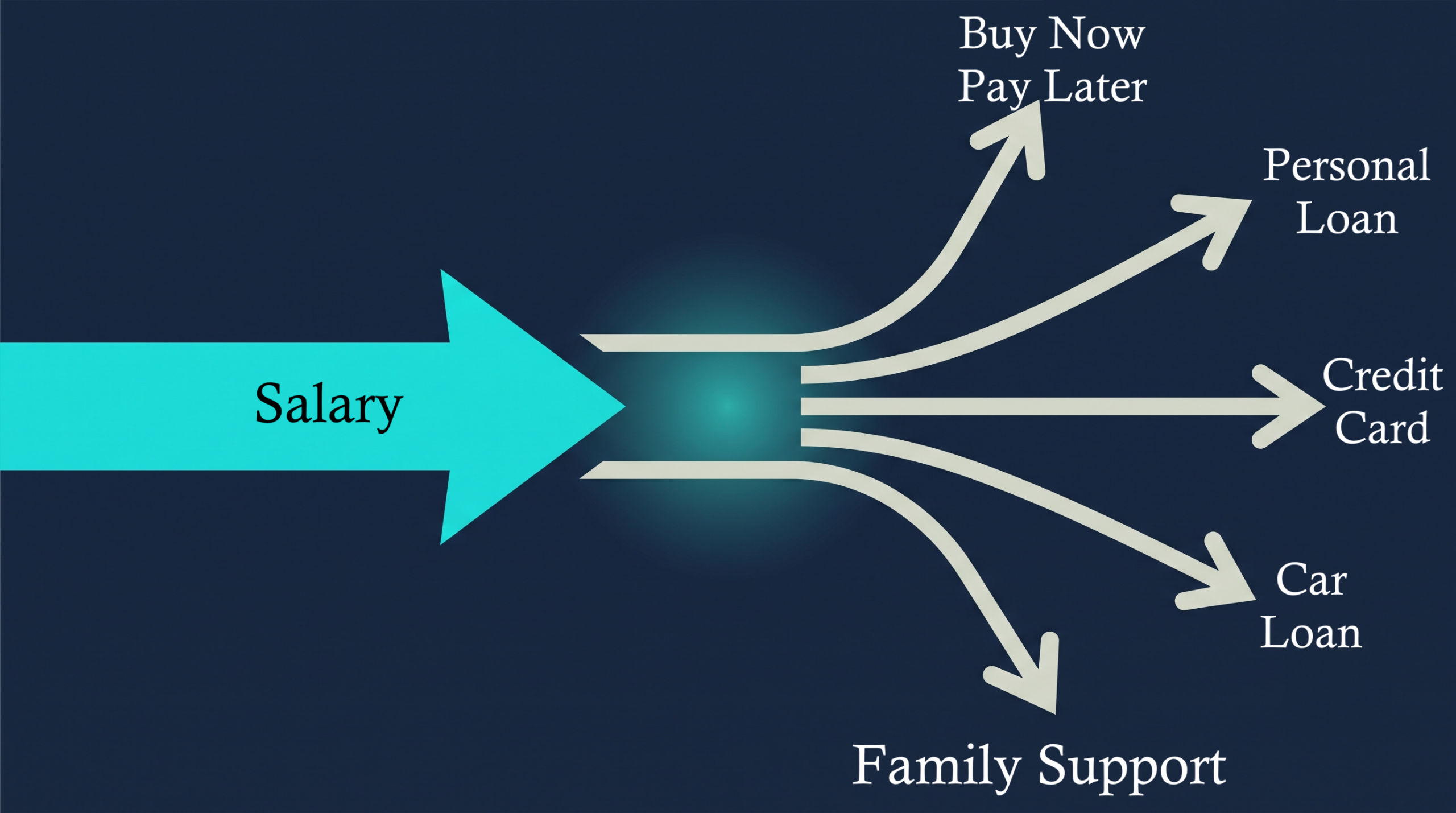
For about three seconds, there's relief — salary has landed. Then the maths starts running in your head, uninvited: loan repayment, card minimum, the transfer you promised your cousin, the small debt you took from a neighbour last month. By the time the maths stops, you already know the truth — most of that money was never really yours. It had somewhere else to be before you did.
You open your banking app the way people open a message they're afraid to read. Quick. Wincing. Hoping the number is kinder than you remember.
Nobody around you knows your real number. Not your spouse, not your closest friend, maybe not even you, not really — because your debts live in five different places, and you've never actually sat down and added them all up in one sitting. All you know is "it's a lot," and that vague fear does more damage than the actual number ever could, because a feeling can't be solved. Only a number can.
So you do what you did last month. You quiet whichever loan is shouting loudest. You tell yourself this is the month you finally sit down and sort it out. Then something happens — a hospital bill, a "please help me small" from home, the generator finally giving up on you — and you borrow again. The cycle doesn't break. It just resets, and you're a month older with nothing changed.
This was never about being careless with money. It's about never once being shown your real numbers, in one place, with an actual plan attached. Nobody's ever handed you that. Until now.
Here's What Nobody Told You
Here's the thing almost nobody explains to you when you're drowning in repayments: debt isn't your problem. Cash-flow blindness is.
Most people assume that if they're struggling with debt, the fix is "make more money" or "spend less." So they try both, half-heartedly, and neither works — because neither one is actually the leak.
The real mechanism is simpler and far more fixable than you've been told: when you have more than one debt, and you don't know your exact total minimum monthly payments versus your exact available income, your brain treats every repayment decision as a separate emergency instead of one solvable system. You end up firefighting five different debts with whatever cash shows up first, instead of directing it with a plan.
There's a specific number sitting inside your finances right now — the gap between what your debts actually cost you every month and what you can actually put toward them. Almost nobody in debt has ever seen that number written down. Once you do, the problem stops being "I'm drowning" and becomes "I have a specific gap of a specific size, and specific gaps can be closed."
The Full Personal Story
My name is Tony, and for a long time, I was the person the last two sections just described.
It started small, the way these things always do. A car repair I put on a card because payday was still ten days out. A "just this once" loan to cover rent when a client paid me late. None of it felt dangerous in the moment — it felt like managing. It was only maybe a year and a half in, somewhere in the thick of juggling several different repayments plus the everyday cost of just being alive, that I noticed I hadn't gone a single month without borrowing something from someone or somewhere.
I remember the evening it stopped feeling manageable. I was sitting on the edge of my bed, doing the same mental math you're probably doing right now — salary minus this, minus that — and I realised I couldn't actually tell you, out loud, in one sentence, how much I owed in total. Not roughly. Not "a lot." I mean I genuinely did not know the number. That scared me more than any single bill ever had.
By then, here's roughly what my situation looked like: four separate debts, minimum payments eating a frightening chunk of what I brought home every month, and a growing habit of solving today's problem with tomorrow's money. I wasn't broke. That was the confusing part. I had steady work. On paper I was fine. In my actual bank app, every month, I was already behind before I'd even started.

So I did what I think most people reading this have already done too:
I tried paying whichever loan felt scariest first.
No order, no strategy — just whichever lender's message made my stomach drop hardest that week. It never actually moved the total number down in any way I could feel.
I downloaded a budgeting app.
I entered everything carefully for about four days. By day five I'd forgotten a transaction, by day seven I'd stopped opening it, and by the following month it was just an icon I felt guilty looking at.
I looked into debt consolidation.
I got as far as reading two adverts and closing the tab both times, because I genuinely couldn't tell if combining everything into one loan would actually help me or just make one bigger, scarier number.
I tried cutting spending for a week.
No small chops, no transport shortcuts, nothing extra. The saving was real but tiny — nowhere near enough to dent what I owed, and I gave up on it faster than I want to admit.
I told myself "next salary" would be the reset.
More times than I can count, the next salary landed and within a week something "unexpected" had already eaten into it — an emergency, a repair, an event I couldn't skip. It wasn't that I lacked discipline. It was that I never had a plan built to survive the unexpected in the first place, so every surprise just became a new loan.
Somewhere around the eighteen-month mark, I stopped waiting for a breakthrough and started asking a different question: not "how do I pay this off," but "why does this keep happening no matter what I try?"
The turning point wasn't dramatic. There was no mentor, no lightning-bolt moment. It was an ordinary Sunday afternoon where I finally sat still long enough to stop avoiding my own numbers. I pulled up every statement I had — cards, loans, the informal ones too — and wrote them all down on one page instead of leaving them scattered across apps and memory. It took less than half an hour. And for the first time, instead of a fog of "I owe so much," I had an actual number I could look at.
From there, I built what eventually became the system inside this page — starting with nothing more than that one page of numbers and a spreadsheet I kept editing every week. It wasn't polished. It wasn't a "product" yet. It was just the only thing that made me feel like I was steering instead of drowning. Over the months that followed, that rough weekly habit turned into a five-step method — Reveal, Eliminate, Strategise, Earn, Track — because that's genuinely the order I worked through it in, one clumsy phase at a time.
I'm not going to tell you this fixed everything overnight, because it didn't, and anyone who tells you that is selling you a fantasy instead of a system. What it did was give me something I'd never had before: one clear number, one clear plan, and a way to measure whether I was actually moving or just spinning. That's what I built The 90-Day Debt Reset to hand you — without you having to spend a year and a half figuring it out the hard way like I did.
The Results Timeline
This is what the 90-day system itself is built to produce, step by step:
You complete the Debt Truth Audit. Every debt, in one place, for the first time. Most people feel the tightness in their chest ease slightly the moment the number stops being a guess.
The Debt Truth Calculator shows you your real monthly cash-flow gap — not a feeling, an actual figure. You know exactly what you're solving for.
Your personal "Things I Will Not Borrow Money For" list is written, and you've gone a full week without a single new loan, card swipe-to-survive, or "just this once" transfer.
Your Debt Attack Map is built. Debt 1 through Debt 4 (or however many you have), in order, with a real monthly number attached to each.
You've found your first real Debt Attack Money — from cut expenses, forgotten refunds, unused subscriptions, or a small side income stream — and it's already gone toward a specific debt.
You've completed a full 30 days of the Weekly Reset rhythm: check, review, release cash, repay, review. It's just what Thursdays are now.
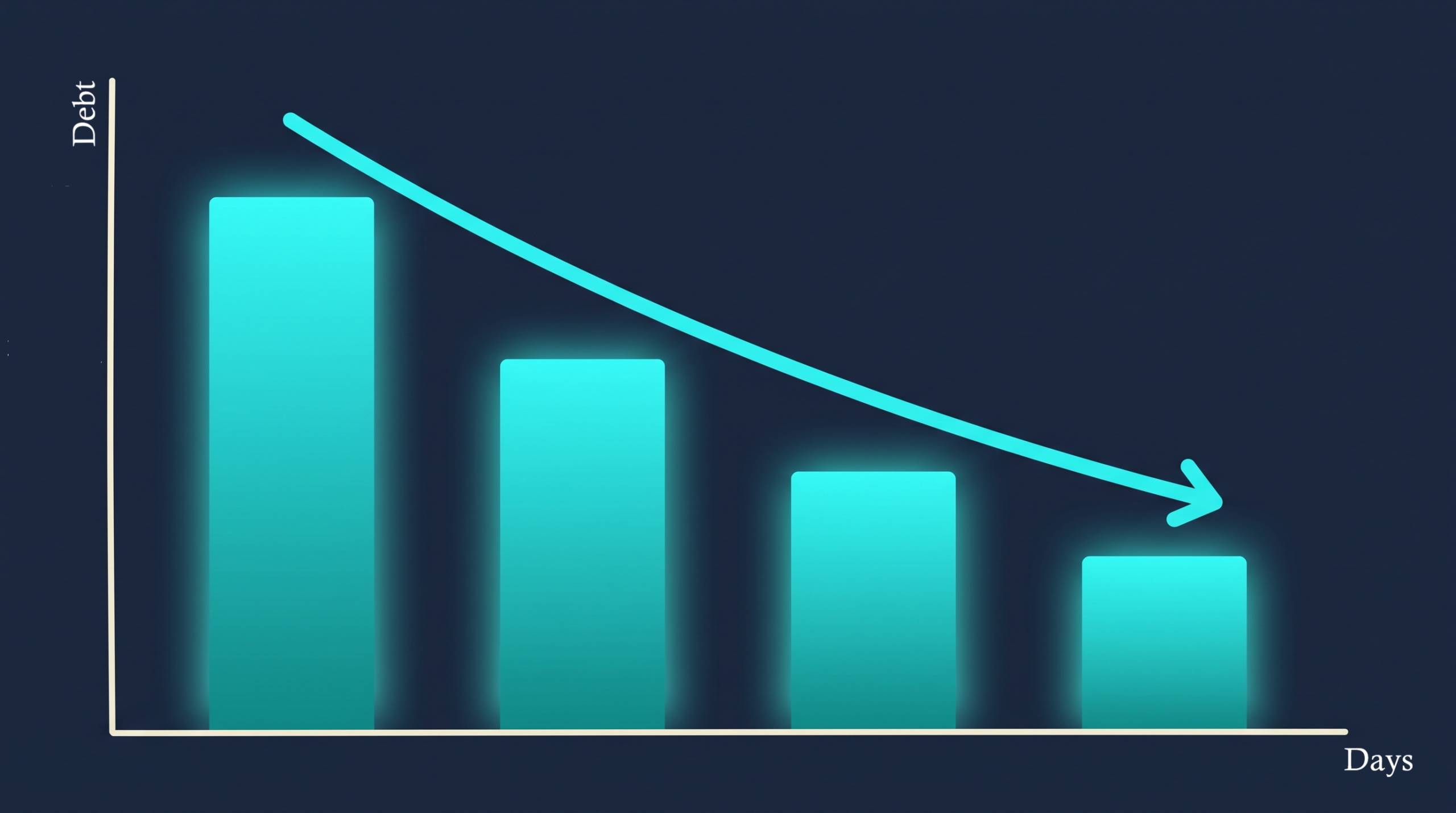
You calculate your starting debt against your current debt, in black and white — a number, a percentage, and a repeatable system for the next 90 days.
Social Proof
"Honestly, I'd tried a lot of things before this. It was the first time anything actually showed me my real number. I didn't realise I was running a ₦165k monthly gap until I calculated it. Now I can plan ahead instead of panicking every time my salary lands."
"The Debt Attack Map na the part wey hook me. I get 4 different loans and I never sabi which one to face first. Now I get order, I get plan, and I don stop dey borrow for small small things."
"I've tried budgeting apps before and never lasted a full week. This one felt different because it didn't ask me to overhaul my whole life in 90 days — it just asked me to face the truth first."
"As someone sending money home and managing my own bills, I never had one clear picture of my debt until I did the audit. Took 20 minutes. Changed how I look at my payday completely."
"I won't pretend it's magic. But the weekly reset routine has genuinely helped me stop the cycle of borrowing to repay another loan. Bit by bit, the number is coming down, and I can actually see it on paper."
The Product Reveal
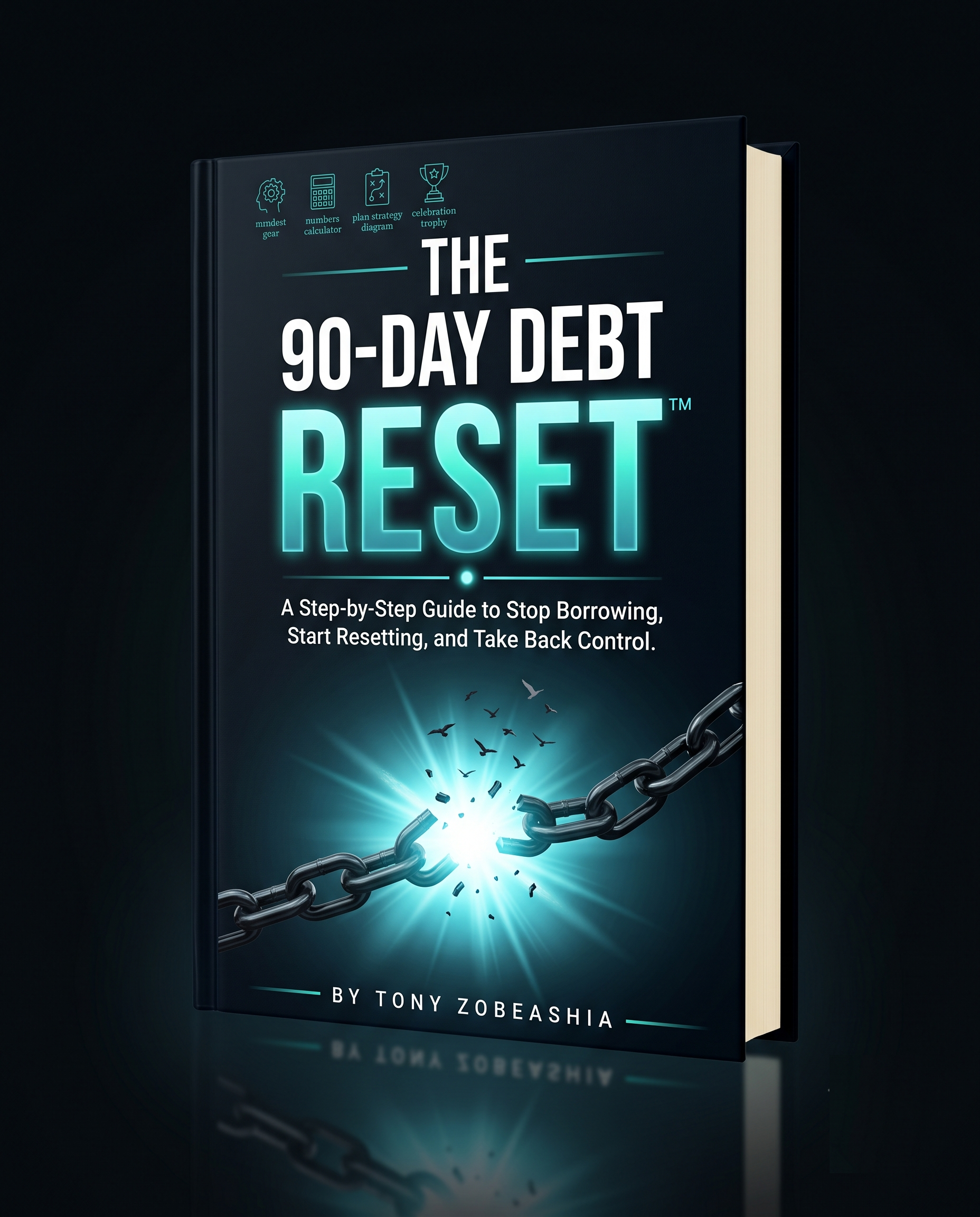
Introducing The 90-Day Debt Reset™ — a guided debt-payoff workbook, calculator, and 90-day action system built around one method: REVEAL → ELIMINATE → STRATEGISE → EARN → TRACK.
- The Debt Truth Calculator & Debt Truth Audit™ — Pages 6–11 — See your total debt, your monthly cash-flow gap, and your real starting point within 15–30 minutes.
- Phase 1: Reveal (Days 1–7) — Pages 12–17 — Your complete financial snapshot: total debt, income, essential and discretionary spending, debt-to-income position.
- Phase 2: Eliminate (Days 8–21) — Pages 18–23 — The Five Debt-Cycle Triggers, the Debt Stop Rule™, and your personal "Will Not Borrow For" list.
- Phase 3: Strategise (Days 22–30) — Pages 24–29 — Debt Snowball vs. Debt Avalanche vs. Hybrid strategy, and your personalised Debt Attack Map™.
- Phase 4: Earn (Days 31–45) — Pages 30–35 — The three sources of Debt Attack Money™ and how to direct every extra naira or pound toward your plan.
- Phase 5: Execute (Days 46–75) — Pages 36–40 — Your Weekly Reset rhythm, laid out so you never have to guess what to do next.
- Phase 6: Track + Reset (Days 76–90) — Pages 41–46 — Your full before/after calculation and your Next 90-Day Plan.
- The Full Toolkit — Pages 47–53 — All 24 tools: calculators, trackers, behavioural worksheets, and income-building sheets.
Bonus Stack
Bonus 1: The Debt-Free Family Boundary Kit (Real value: ₦10,000)
The scripts and worksheets for the hardest part of getting out of debt — saying no to the people you love. Includes the Family Money Boundary Planner, the Social Spending Control Sheet, and the Emergency Expense Decision Tree, so the next "please just help me this once" has an answer that protects your plan without damaging your relationships.
Bonus 2: The 30-Day Side Income Challenge (Real value: ₦10,000)
A structured, day-by-day plan for creating extra Debt Attack Money from what you already have — skills, time, and unused items — including the Extra Income Opportunity Finder, the Sell-It-for-Debt Worksheet, and the Income Allocation Calculator.
Bonus 3: The Lender & Loan App Negotiation Kit (Real value: ₦9,000)
The scripts for the conversation most people avoid — not with the people you love, but with the people you owe. Includes the Fee Waiver Request Script, the Repayment Restructure Template, and the Loan App Harassment Response Guide, so you can ask a bank, card issuer, or loan app for real room to breathe instead of waiting for them to offer it.
Bonus 4: The Debt-Free Maintenance Plan (Real value: ₦15,000)
What happens after Day 90, so the reset doesn't quietly reverse itself. Includes the Emergency Buffer Starter Plan, the Quarterly Money Check-In, and the Relapse Warning Signs Checklist, so your newly freed-up cash flow builds a cushion instead of drifting back into new debt.

Offer Summary
| Item | Value |
|---|---|
| The 90-Day Debt Reset™ — full workbook, calculator & 24-tool system | ₦25,000 |
| Bonus 1: The Debt-Free Family Boundary Kit | ₦10,000 |
| Bonus 2: The 30-Day Side Income Challenge | ₦10,000 |
| Bonus 3: The Lender & Loan App Negotiation Kit | ₦9,000 |
| Bonus 4: The Debt-Free Maintenance Plan | ₦15,000 |
| Total Real Value | ₦69,000 |
| Your Price Today | ₦14,950 |
The Guarantee
🛡️ The "See Your Real Numbers" Guarantee
Complete the Day 1–7 Debt Truth Audit. If you don't feel clearer about your numbers than before you started, email us within 60 days for a full refund — no argument, no guilt trip.

Two-Option Close
Option 1: Close this page.
Nothing changes. Payday comes, the usual list of repayments empties it before you've had a chance to breathe, and something unexpected shows up like it always does. You already know how that story goes.
Option 2: Act right now.
Ninety days from today, you know your exact number instead of a guess. One debt attack sequence instead of five conflicting ideas. Weeks without a single new loan. A number that has visibly, measurably moved.

Triple P.S.
P.S. Remember, this comes with the See Your Real Numbers Guarantee — complete Day 1–7, and if it doesn't give you clarity, you get every naira back within 60 days.
P.P.S. This founding price is only for the first 200 copies — after that, it moves to ₦25,000.
P.P.P.S. You already know how this month ends if nothing changes. You've lived it before. The only real question is whether you want to spend today the same way, or spend fifteen minutes seeing your actual number for the first time.